The Human Edge: Why Soft Skills Matter in the AI Age
As AI tools become more common, it’s our soft skills that will set us apart.
.jpg?sfvrsn=baa0070_1)
At a Glance: Soft Skills Employers Look For In the AI Era
- AI is changing work but soft skills remain critical for career success
- Employers value skills like communication, collaboration, and problem solving alongside technical and digital skills
- As automation grows, human judgement and emotional intelligence become key differentiators
- Teams with strong interpersonal support complemented by digital adoption are high-performing
- In Singapore, critical core skills can be built through on-the-job learning, structured courses, and a continuous growth mindset
|
What AI Can’t Replace: The Rising Value of Soft Skills
AI is changing everything, reshaping industries, workplaces, and everyday life at speed. It’s a phrase we’ve been hearing for years now. Yet beneath all the excitement about innovation, automation, and new possibilities, one reality is becoming clearer: the skills likely to matter most in an AI-driven world are deeply human.
For many professionals, this is not a new idea. Success at work has long depended on more than just technical ability or academic grounding. In most roles, performance is shaped by how well individuals are able to apply what they know and can do in real situations—often through how they communicate with others, how they work across teams, and how they adapt as work evolves.
As work becomes more complex and less routine, these human elements increasingly form the human edge that determines how effectively knowledge and technical skills translate into outcomes.
AI’s Impact on Work and Skills
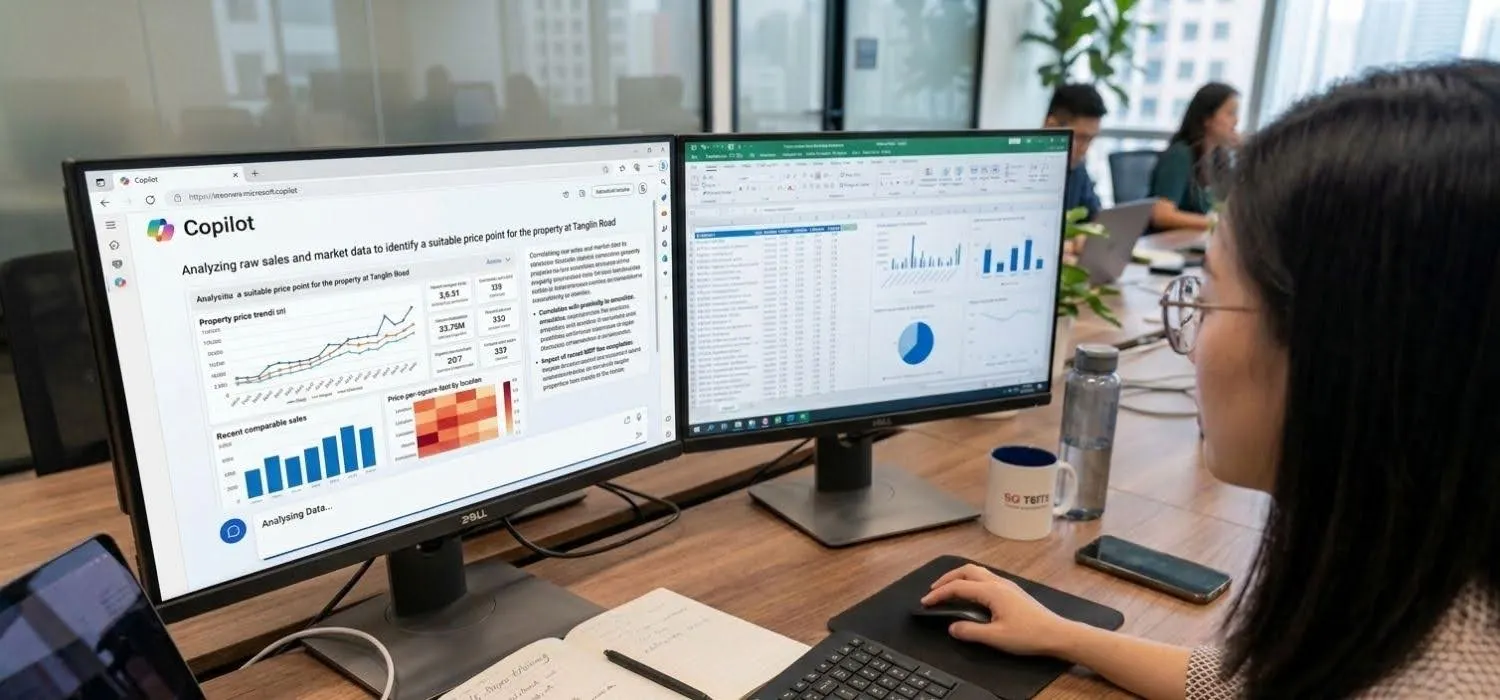
The way work is being done is already changing with AI. Tasks that are routine and repeatable are increasingly being automated with information now being processed and generated at a scale and speed that was not possible before.
But the more meaningful shift is not just technological, it is organisational and human. Increasingly, the differentiator is not AI tools, it is how people and teams work with them. A
Deloitte survey found that high-performing teams score higher on enduring human capabilities such as emotional intelligence, and tend to operate in ways that are grounded in mutual respect, inclusivity, and agility.
These same teams are also more likely to use AI than others, with adoption levels at 78% compared to 54%. But the difference is not the technology itself. Rather, it is that these teams are already strong in the ways they work together, which allows them to adopt and use tools like AI more effectively.
The research reveals what many instinctively know: technology plays an enabling role, but it is the human qualities within teams that determine how effectively it is used and ultimately how well those teams perform.
What are Critical Core Skills?
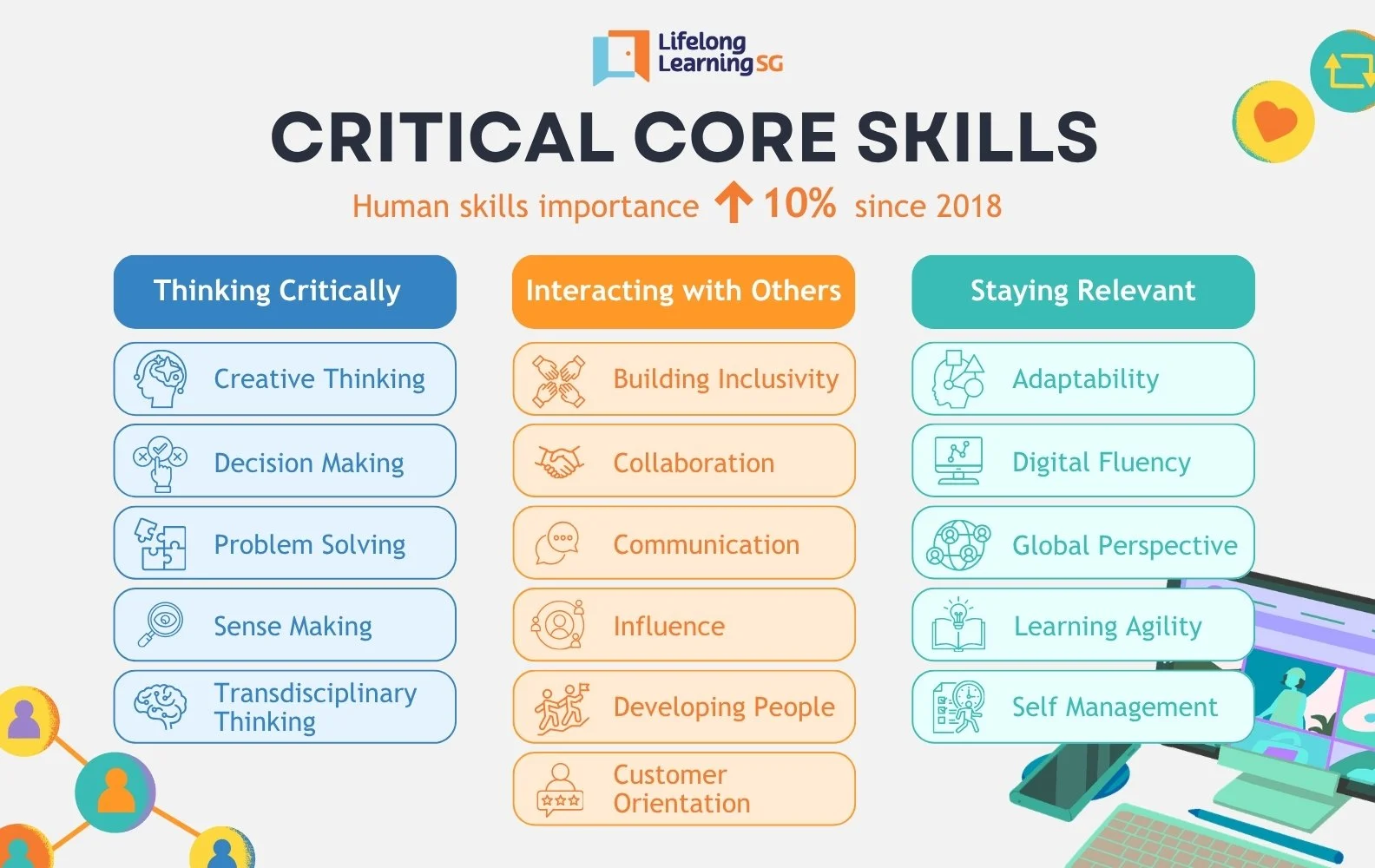
Critical Core Skills (CCS), more commonly known as soft skills, are the everyday, transferable skills people rely on to navigate work across different roles and situations. Unlike technical skills, which are often tied to specific tools or industries, CCS remain relevant even as work evolves.
The Skills and Workforce Development Agency (SWDA) defines them as 16 core skills identified by Singapore employers as the most critical to thrive in the future economy. These skills are categorised into three broad areas: thinking critically, interacting with others, and staying relevant.
5 Critical Core Skills to Cultivate
While all CCS are relevant in different ways, some are more commonly emphasised across job descriptions and workplace expectations. Five in particular stand out:
1. Communication
Communication is one of those skills that consistently shows up as essential across almost every role, according to LinkedIn’s
Work Change Report. It sits at the centre of how people work together whether that is sharing ideas, aligning expectations, or building working relationships.
It has also taken on a new dimension in an AI-enabled workplace. Knowing how to communicate clearly is increasingly important not just when working with people, but also when interacting with AI tools. How questions are framed, how context is given, and how outputs are refined can all shape the quality of results.
At its core, communication enables the clear exchange of ideas and the building of trust and relationships, something that still cannot be fully replicated by AI.
2. Developing People
Leadership qualities are increasingly valued in the workplace and are no longer limited to formal management roles. They are reflected in how people support others’ growth through guidance, feedback, and shared learning in everyday work.
Deloitte found that teams with a culture of apprenticeship were almost three times more likely to be high performing. In these teams, 68% of people take time to help each other learn and grow. These interactions strengthen both individual capability and team performance, contributing to organisational goals over time.
As workplaces become more shaped by AI, developing people remains important to ensure human capability grows alongside technological change.
3. Digital Fluency
Working with digital tools such as AI has become part of everyday work, but digital fluency today goes
beyond basic usage.
It is about knowing how to apply these technologies in meaningful ways, understanding their strengths, recognising their limits, and using them to support better work rather than relying on them blindly.
4. Collaboration
Work today rarely happens alone. Most roles involve working across teams, functions, or organisations, so it’s important to align different perspectives and work through differences.
People bring different working styles, priorities, and ways of thinking, so progress depends on how well these differences are understood and bridged. Success is often less about individual output and more about working together towards shared goals in a way that works for everyone.
As collaboration becomes more distributed and digital, it now often happens across both in-person and virtual settings. Being able to work well with others across these different contexts is also becoming increasingly important.
5. Problem Solving
If there’s one thing that stays constant in the workplace, it is change. The ability to handle difficult or unexpected situations by generating effective and efficient solutions becomes especially important.
While digital tools, including AI, can quickly surface information and possible options, it is still human judgement that is needed to understand context, weigh trade-offs, and decide on the best course of action.
Strong problem solvers are therefore not just reactive, but are able to make sense of complexity and act with clarity even when they do not have all the information.
How to Develop Your Critical Core Skills
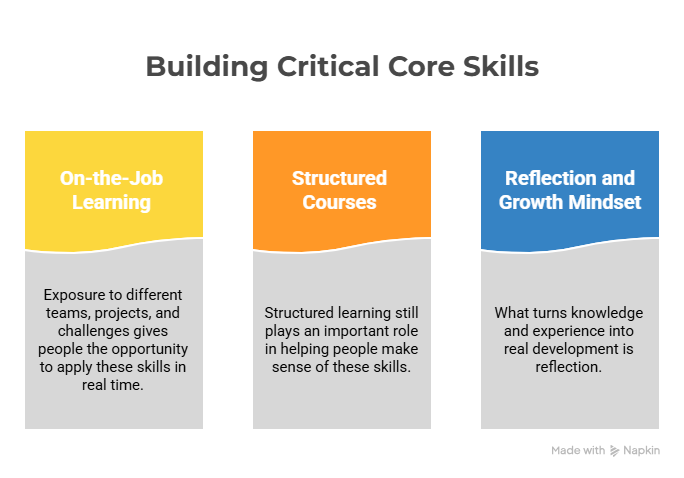
Critical Core Skills are developed over time, through a combination of everyday experiences and more intentional learning. Some of the most meaningful development happens outside structured settings, such as through volunteering, familial responsibilities, or handling difficult real-world situations. These experiences naturally strengthen how people communicate, collaborate, and solve problems in practice.
Here are a few ways to build these skills.
On-the-Job Learning
A large part of development happens directly at work. Exposure to different teams, projects, and challenges gives people the opportunity to apply these skills in real time.
It is often in these situations that individuals learn how to adapt, communicate under pressure, and work through complexity in ways that cannot be fully simulated in a classroom.
Structured Courses
Structured learning still plays an important role in helping people make sense of these skills, giving them the language and frameworks to understand them more clearly. Courses can help you identify your strengths and development areas, while providing practical tools you can apply directly at work.
They are often a useful starting point for more intentional growth. One great way to find such courses is through the MySkillsFuture platform where there are almost 200 courses on the 16 CCS.
Reflection and Growth Mindset
What turns knowledge and experience into real development is reflection. While often overlooked, taking the time to think about what went well, what could have been done differently, and what was learned helps strengthen awareness over time.
A growth mindset also plays an important role, as it keeps you open to feedback, new experiences, and continuous improvement rather than seeing skills as fixed.
Human Skills Matter Even More in an AI-Driven World
As AI becomes more embedded in everyday work, tools are becoming widely accessible across almost every role. When that happens, they stop being what sets performance apart. What once differentiated people in terms of speed or output is increasingly becoming baseline capability.
This is where human skills take on greater importance. They are not just about working effectively with technology, but about shaping intent, direction, and meaning in how work is done. In a world where execution is increasingly automated, what becomes distinctive is the human ability to decide what matters, why it matters, and what should happen next.
Building these capabilities is often less about a single course or decision, and more about taking small, intentional steps over time. If you’re looking to upgrade your soft skills but are unsure where to start,
Career & Skills Advisory is a free resource you can tap on. In a 30 to 45-minute personalised consultation with a Career & Skill Advisor, you can gain a clearer understanding of the skills needed for your career, training courses suited to your needs, and learn about available funding schemes.
Looking for a simple, no commitment way to explore courses? Get the latest updates on all our upcoming events by following our Instagram page.
In Singapore’s evolving job market, the most important soft skills, also known as Critical Core Skills, include communication, collaboration, problem solving, digital fluency, and the ability to develop people. These skills are prioritised by employers because they remain relevant across industries, even as AI and automation reshape technical job requirements.
As AI tools automate routine and technical tasks, soft skills are becoming the key differentiator between average and high-performing professionals. Human abilities such as emotional intelligence, critical thinking, and effective communication help individuals apply AI insights meaningfully, collaborate with others, and make informed decisions. These skills also enable teams to adopt AI more effectively and achieve better outcomes.
You can improve your soft skills through a combination of on-the-job experience, structured training, and self-reflection. Platforms like MySkillsFuture offer a wide range of courses aligned with SkillsFuture’s Critical Core Skills framework. Additionally, participating in workplace projects, volunteering, and seeking feedback can help you build real-world communication, collaboration, and problem-solving abilities.
Soft skills are not necessarily more important than technical skills, but they are increasingly seen as equally critical. While technical skills help you perform specific tasks, soft skills determine how effectively you apply those skills in real-world situations. In Singapore’s competitive job market, employers value candidates who can combine both technical expertise alongside strong communication, teamwork, and adaptability.
Future-proofing your career in Singapore involves combining digital skills with strong soft skills. While learning how to use AI tools is important, long-term career resilience comes from abilities like critical thinking, adaptability, and collaboration.
Posted on 5/7/2026 9:00:00 AM