6 Powerful Ways To Upskill Your Employees
Are you making full use of the support and grants available?

Fuel Your Team's Growth: Your Ultimate 6-Step Upskilling Strategy
In Singapore’s fast-paced economy, it’s natural to wonder, how ready is your workforce for what’s ahead?
Keeping your team's skills sharp has never been more important for navigating today's dynamic work landscape. And the numbers back this up: In 2025, a whopping 247,000 workers received employer-supported training—a notable 2.5% increase from the previous year, according to SkillsFuture Singapore (SSG).
That's a clear sign that upskilling and reskilling is becoming a priority across workplaces. With AI transformation picking up pace and growing emphasis on continuous learning, helping your team grow their skills is now a smart and essential strategy for any business.
Consider Your Upskilling Strategy
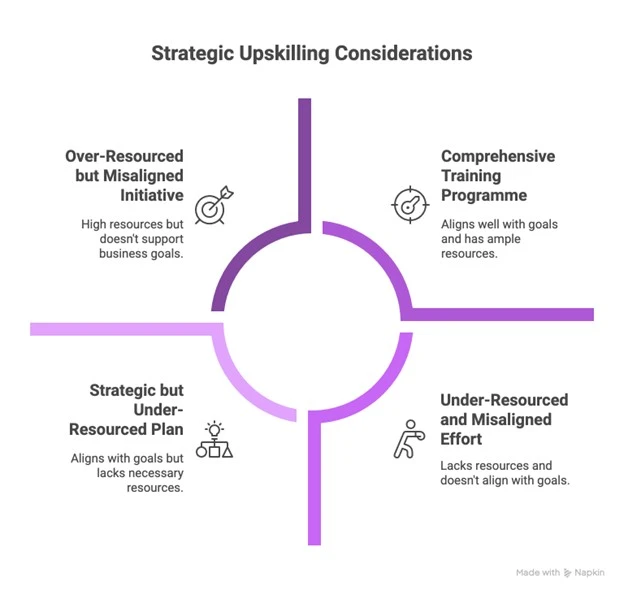
Here are some key things your organisation should actively consider when building its upskilling strategy:
- Time: You'll need to figure out how much time your employees can realistically dedicate to training without disrupting their daily tasks too much. Finding that balance is crucial for effective learning and smooth operations.
- Capital: Upskilling often involves financial investment. This means budgeting for course fees, new software licenses, or even bringing in external trainers to ensure your team gets the best possible instruction.
- Resources: Beyond just money, consider the practical resources you have or need. Do you have internal experts who can train? What about access to robust online learning platforms or specialised tools that can support continuous development?
- Business and Organisational Level Objectives: Your upskilling efforts should directly align with your company's strategic goals. What is your business trying to achieve in the next one to three years? Your training should actively support that vision, ensuring every investment helps propel your organisation forward.
Benefits of Career Upskilling

Investing in upskilling programmes for your team offers a ton of perks – it's a win-win for both your employees and your organisation. Check out some of the big ones:
- Increased Productivity and Business Growth: Well-structured upskilling programmes directly make your workforce more efficient, helping them save time, cut down on errors, and actually hit their targets more effectively. This, in turn, really boosts your business's bottom line and helps fuel overall growth. In fact, a LinkedIn study even points out that effective employee development can boost performance by up to 25%.
- Enhanced Employee Retention: Companies that put professional development first often see much higher employee retention rates. That same LinkedIn study dropped a pretty compelling statistic: a huge 94% of staff would actually stick around longer if their company invested in their career growth.
- Prevention of Career Stagnation: Upskilling actively helps keep your employees’ skills sharp, so they don't become outdated in today's fast-changing world. This proactive approach doesn't just promote lifelong learning; it also really boosts job satisfaction. The Workplace Learning Report 2024, for instance, reveals something striking: Eight in 10 people actually feel learning genuinely adds purpose to their work.
What is Upskilling?
Upskilling is about helping your existing employees learn new skills or enhance the ones they already have, preparing them for future roles or new demands within your organisation. It's not just about filling immediate skill gaps; it's a proactive investment in your workforce's long-term capability and adaptability.
The Singapore government reinforces this in Budget 2026, through the Enterprise Workforce Transformation Package, which provides funding of up to 70% for workforce transformation, job redesign, and reskilling initiatives.
This support helps employers equip their teams for technological shifts and ensures workers remain relevant and competitive.
Upskilling Examples
Take manufacturing, for instance. The Knowledge Transfer Office – which covers A*STAR’s SIMTech and the Advanced Remanufacturing and Technology Centre (ARTC) – is actively partnering with SkillsFuture Singapore and NUS-ISS.
Their collaboration aims to offer targeted training in things like cloud-native solutions, containerisation, and DevSecOps for innovative manufacturing services. It's all about making sure our workforce stays competitive and adaptable in that evolving landscape.
Is Upskilling and Reskilling the Same Thing?
While people often use them interchangeably, upskilling and reskilling are actually quite different approaches when it comes to developing your team’s skills:
Upskilling means equipping your existing employees with advanced knowledge or new skills that directly enhance their current roles.
For instance, if you invest in a marketing executive learning advanced data analytics to optimise their campaigns, that's upskilling in action for your team. This path is perfect when you're looking to really boost your team's current performance, enable them to take on more complex tasks, and help them progress within their existing career tracks.
One example is supporting a hospitality professional on your team as they take courses in software development; with these new tech skills, they could then help your organisation adapt to digital tools or even develop new customer-facing platforms.
Creating an Effective Upskilling Strategy
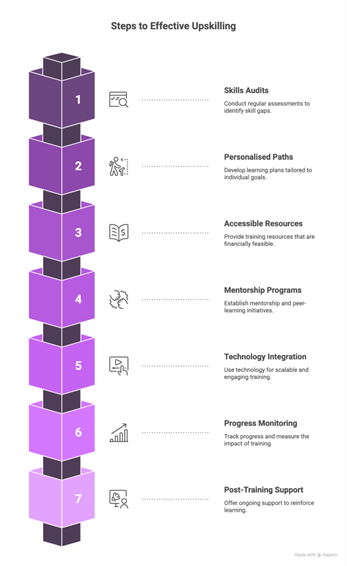
Ready to boost your team's capabilities? To truly make a difference, you need a well-thought-out upskilling strategy. This means actively considering several key factors to ensure your efforts deliver real results for your business:
1. Conduct Regular Skills Audits to Identify Gaps
By doing this consistently, you effectively identify precisely where your workforce needs to grow, ensuring every upskilling dollar you spend directly strengthens your operational capabilities and keeps your business competitive for tomorrow's challenges.
2. Implement Personalised Learning Paths
When learning feels relevant and truly engaging, employees tend to retain knowledge better, and their individual growth naturally aligns more closely with your organisation's overall success.
3. Use Accessible Training Resources
Once you've got your strategy mapped out, the next big step is making sure your team can actually access the training they need. In 2026, the SkillsFuture Workforce Development Grant (WDG) has been launched to provide a single application channel and up to 70% funding support for training, job redesign and workforce transformation initiatives, helping you build the skills your team needs for the future.
You can also tap on the current SkillsFuture Enterprise Credit (SFEC) — a one-off S$10,000 credit that covers up to 90% of eligible training and transformation costs. The existing SFEC runs until November 2026, so if your company hasn’t used it yet, now is the perfect time.
But if you're a relatively new SMC and not eligible for the current tranche of SFEC, not to worry, the redesigned SFEC will launch in the second half of 2026, giving all qualifying companies a fresh S$10,000 digital wallet that can be used immediately to offset costs.
Alternatively, you can also explore tools like the GoBusiness e-Adviser to easily find personalised training programmes and available funding options that best suit your business needs.
Upskilling Programmes for Employees
Beyond these, it's also smart to seek out personalised guidance. This can be key in pinpointing specific skill gaps within your organisation and finding tailored training solutions for your unique workforce.
Develop Mentorship and Peer-Learning Programmes
Implementing structured mentorships, where senior staff guide junior colleagues on skill development, alongside peer-learning circles focused on specific skills, can also enhance this. These approaches don’t just leverage the expertise of those in the team — they foster a continuous learning culture that hinges on mutual support and growth.
4. Utilise Technology for Scalable Training
You might even consider incorporating interactive tools like virtual reality (VR) or augmented reality (AR) for even more engaging sessions. A PwC study on VR's effectiveness for soft skills training found that V-learning is the most cost-effective way to learn when done at scale, and participants actually completed training four times faster than traditional classroom methods.
This highlights how these immersive technologies don't just make learning fun; they make it incredibly efficient and impactful for your business.
5. Monitor Progress and Measure Impact
To find out if your upskilling efforts are really paying off, you need to track your employees’ progress and measure their results. Setting clear learning goals and using the right metrics lets you see if training leads to real improvements and benefits your business.
For each upskilling programme, define specific, measurable goals. Then, use Learning Management System (LMS) tracking features or regular assessments to monitor staff progress.
By actively monitoring and measuring, you gain valuable insights into what's working and what might need a tweak, helping you ensure a better return on your investment.
6. Create Post-Training Support Systems
Learning doesn't stop when the training is over. To make sure these new skills stick and get used, it's important to give your employees ongoing support and resources after they’ve finished their upskilling programmes. This means putting follow-up efforts in place, like refresher workshops, one-on-one coaching or dedicated online support platforms.
Upskilling as a Long-Term Investment for Business Success
Ultimately, investing in your employees' growth not only helps your business succeed in the long run, but also fuels individual career paths and keeps them engaged in their evolving roles. By creating a workplace where mentorship thrives and using technology for flexible training, you can build a team ready for whatever the future holds.
Find out more about the latest changes and how your company can benefit from the Enterprise Workforce Transformation Package (EWTP).
Posted on 3/26/2026 9:00:00 AM