How To Choose The Right SkillsFuture Course For Upskilling in Singapore

Finding the Right SkillsFuture Course: What to Consider Before You Enrol
At a Glance:
|
But which would employers in your target role actually value? Will completing one of these make hiring managers take your application seriously, or are you investing time in a credential that sounds impressive but doesn't translate to the jobs you want?
This is the challenge many mid-career learners face: knowing which skills to invest in and whether their time, effort, and training choices will translate into real career opportunities.
Whether you're looking to switch careers, grow in your current role, or simply pick up a new skill that adds value to your future, this guide will help you make a more informed choice. We'll walk you through what to look for, what to avoid, and how to find a course that fits not just your career goals but also your lifestyle and learning habits.
Start With Your Goal
Your answer will make it much easier to narrow down the right options. Most people fall into one of these three categories:
Career Switch
For example, an operations manager moving into data analytics can build on project management and process knowledge, but will need to develop technical skills. An HR manager moving into talent acquisition can leverage relationship-building skills but may need to learn recruitment-specific tools and frameworks.
Look for structured programmes with recognised certifications, practical projects, and strong industry credibility, such as the SkillsFuture Career Transition Programme (SCTP). It’s a huge bonus that such programmes also offer employment facilitation services and career advisory to enhance your job prospects!
Career Progression
If you enjoy your current industry but want to move into a higher-paying role or take on more responsibility, focus on filling skill gaps that employers value. For example, a digital marketer could benefit from learning data analytics, AI tools, automation, or leadership skills.
The goal is to become more valuable in your current field and stay competitive as jobs evolve.
Personal Enrichment with Practical Value
Once you're clear on your goal, choosing a course becomes much less overwhelming. Instead of trying to evaluate every option available, you can focus only on the ones that genuinely help you get where you want to go.
Steps To Finding SkillFuture Credit-Eligible Courses
1. Search on MySkillsFuture Portal
Start by searching on the official MySkillsFuture portal. Not only is that a sure way to find quality-vetted courses, you could also use your SkillsFuture Credit for all the courses listed.

You can also use filters to narrow by topic, schemes, duration, format, and commitment level.

2. Compare Three Courses Side-By-Side
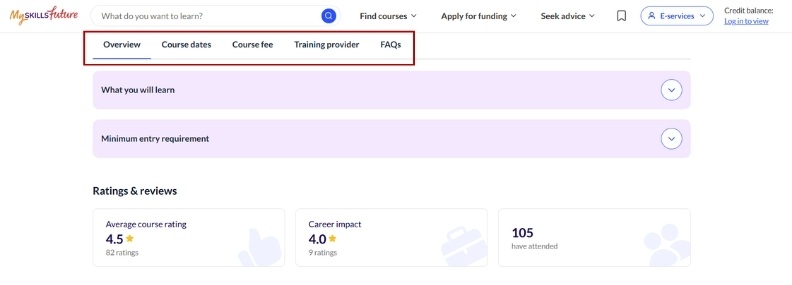
Don't overthink this. For each course, navigate through the various tabs and check:
- Ratings and reviews by learners
- Next available course date and schedule fit
- Real cost after using your credit
- Relevance to your current job and the job market
3. Read the Full Course Details
To be specific, you should always check these sections under the course overview and ensure they match your goals:
- What you will learn
- Skill you will pick up
- Course outline (if available)
If details about the actual learning outcomes are unclear, it’s worth taking a closer look. For more information, visit the training provider’s website or search for the course name directly to find out more about what the course covers and what you can expect to learn.
Key Factors to Assess Before Enrolling
Before signing up for any course, take a closer look at the details beyond just the title and price. A course may sound impressive, but the right fit depends on your schedule, learning style, and career goals.
Factor | What To Look Out For |
Duration | Check the total course hours, weekly workload, and any additional time needed for assignments, readings, or practice. Be realistic about whether you can commit. |
Delivery Format | Consider whether the course is conducted online, in-person, or hybrid. Hands-on skills may benefit more from classroom sessions or practical workshops. |
Learning Format | Decide whether you learn better through live classes or self-paced learning. For example, online Coursera courses are great for those who need flexibility but this requires stronger self-discipline. |
Funding Support & Eligibility | Check if the course is SkillsFuture Credit-eligible, WSQ-supported, or part of programmes such as SkillsFuture Career Transition Programme (SCTP). These may affect the subsidies or allowances you can receive. |
Trainer & Course Quality | Look at trainer experience, learner reviews, and course ratings such as Training Quality And Outcomes Measurement (TRAQOM) scores. A good trainer can make a big difference in your learning experience. |
Ensure the Course Aligns With Singapore’s Job Market
Explore the Top Picks and skills for emerging job roles on the newly revamped MySkillsFuture portal. These sections highlight courses and career pathways based on current skills demand, helping you discover areas you may not have considered.
You can also explore the skills required for each job role. For example, if you are interested in becoming a cybersecurity analyst, data analyst, or software engineer, you can see the key skills employers look for and identify suitable courses to build those capabilities.

Also check whether your target industry has local certification or regulatory requirements. For example, finance roles may require specific regulatory knowledge, while built environment roles may value certifications aligned with BCA standards. The best courses should reflect the expectations of the Singapore job market.
Choose a Course You’ll Actually Finish
Many learners drop out not because the content is too difficult, but because the commitment does not match their schedule.
Start small if you're rusty
A few-week course first builds the learning habit. Then tackle longer commitments.
Treat study time like a meeting
Pick a slot (Saturday morning, Tuesday nights) and guard it. Consistency beats intensity.
Match commitment to your life
A course that requires weekend classes, projects, and assessments may be manageable for someone with a flexible schedule but challenging for someone balancing work and family commitments.
Know your learning style
Do quizzes and rote tests make you miserable? Seek participation-based assessment. Prefer flexibility? Self-paced learning. Need structure? Go live.
Seek Advice and Help If You Are Unsure
FAQs
Your opening SkillsFuture Credit of $500 can be used for any course listed on MySkillsFuture. If you are 40 and above, you will also have your $4,000 Mid-Career SkillsFuture Credit. This can only be used on eligible longer courses intended for reskilling such as SkillsFuture Career Transition Programme (SCTP) courses.
While PRs receive significant baseline subsidies for many courses, only Singapore Citizens get SkillsFuture Credit when they turn 21 and another tranche of the Mid-Carrer SkillsFuture Credit when they turn 40.
It depends on your goal. Short courses are useful for exploring a new skill or filling a specific gap, while longer programmes may be more suitable for career switches or gaining recognised qualifications.
For bigger career changes, consider structured programmes such as SkillsFuture Career Transition Programmes (SCTP), which are designed for reskilling into growth sectors.
Posted on 8/7/2026 9:00:00 AM