Learning Resources

Articles

SkillsFuture SCTP Courses vs Part-Time Diploma in Singapore: Which Should You Choose?

Pick the right path to boost your career.

sctp career switch diploma courses


At a Glance: SCTP vs Part-Time Diploma Courses

  • Duration: 3 - 12 month SCTP; 1 - 2.5 years Part-Time Diploma
  • Focus: SCTP builds job-ready, practical skills; Part-Time Diploma provides formal, recognised qualifications
  • Flexibility: Both offer part-time and blended learning options, but SCTP is designed for quicker workforce entry
  • Cost & Support: Both are heavily subsidised; SCTP also includes career support and job facilitation

Choosing Between Fast-Tracked Learning with SCTP or a Structured Diploma

In a competitive job market, many are now seeing the value in constantly upskilling themselves. For Singaporeans, SkillsFuture programmes and initiatives have made it easier than ever for working adults to build new skills or deepen their expertise in their field. 

If you’ve done your research, two particular pathways might stand out for you: the SkillsFuture Career Transition Programme (SCTP) for fast, skills-focused training to pivot your career, and part-time diploma courses for a structured, formally recognised qualification that enhances long-term prospects while you continue working.

At first glance, they might seem similar, both flexible, subsidised, and designed for adult learners. But dig a little deeper, and you’ll find key differences in their course formats. 

So how do you decide which one is right for you? The answer lies in understanding your goals, timeline, and what kind of qualification you truly need.

This article will guide you through everything you need to know to make the right path for yourself.


What is the SkillsFuture Career Transition Programme (SCTP)?

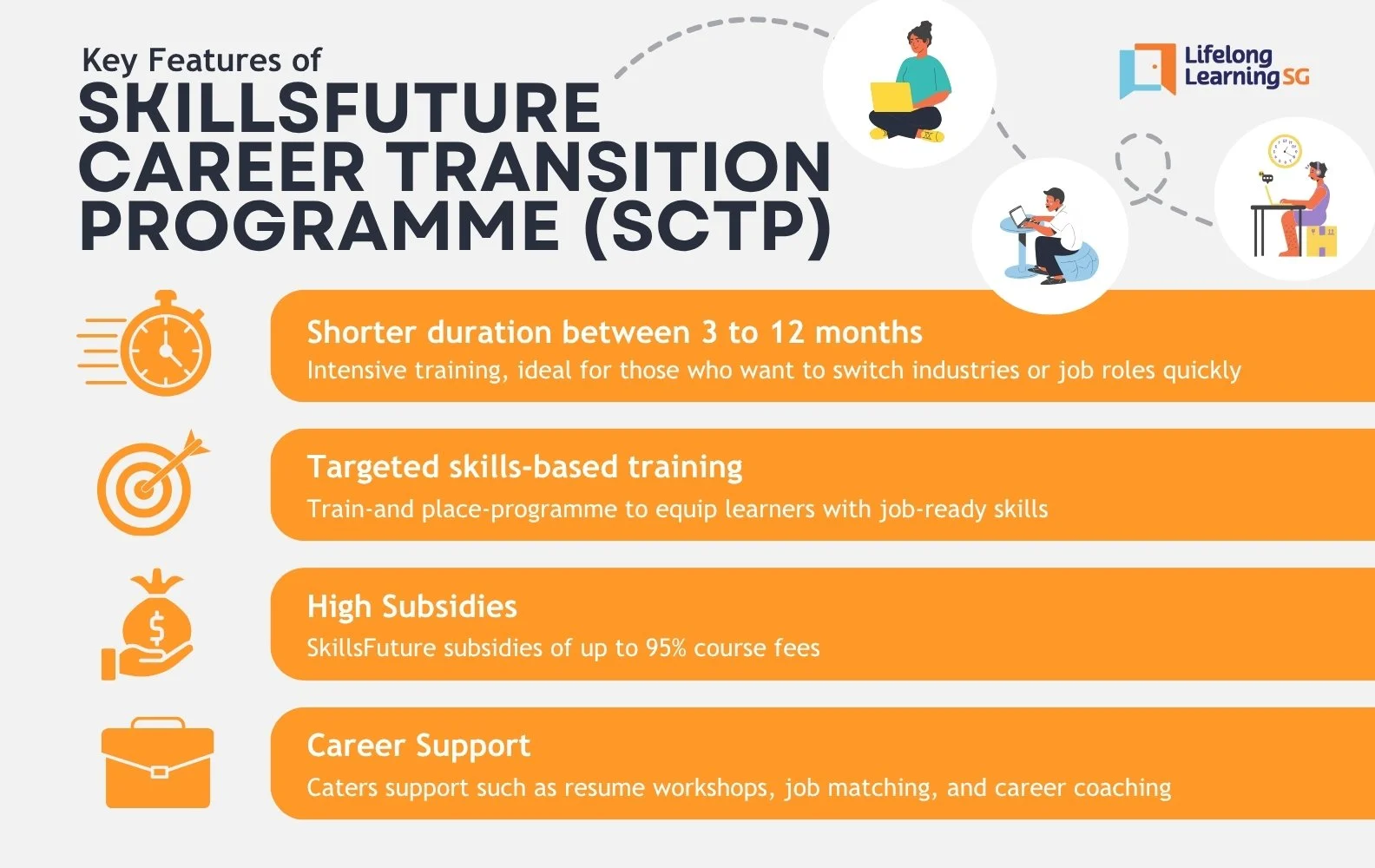
SCTP is tailored primarily for mid-career individuals looking to efficiently switch industries or job roles. It is a “train-and-place” programme, meaning it doesn’t just teach you the skills, it also helps you transition into employment.
skillsfuture career transition programme sctp


Shorter Training Duration 

One of its biggest advantages is speed. SCTP modules typically run between 3 to 12 months, making them significantly shorter than traditional formal qualifications.

For example, NTUC LearningHub’s SCTP Data Analyst course takes just over 4 months while the part-time course spreads the learning hours over a longer period of 9 months.


Flexible Lesson Formats
With both part-time and full-time formats, SCTP programmes offer some flexibility for adult learners to plan around their work and personal lives.

There are also varying course delivery methods ranging from classroom delivery, online, or hybrid models. 


Targeted Skills-Based Training

These programmes are highly targeted, focusing on industries with strong hiring demand like Early Childhood, Financial Services, and Digital Infocomm and Media Industries.


Cost-Effective with High Subsidies
Another major draw of the SCTP programme is its affordability. There is baseline funding of up to 70% of course fees. And individuals 40 and above, there is enhanced funding of up to 95% course fees.

Beyond that, both full-time and part-time SCTP courses are eligible for Training Allowance (TA) to help defray costs while you train.


Career Support Beyond The Classroom
On top of all that, SCTP courses offer employment facilitation and career advisory services to help enhance your employment prospects, from resume clinics to interview preparation and job-matching assistance.

In short, SCTP courses are built for speed, practicality, and employability. At the end of the day, you’ll be awarded with a certificate and real industry experience under your belt.


What is a Part-Time Diploma?

A Part-Time Diploma is a more formal academic qualification offered by polytechnics and other accredited training providers. This is also a popular choice for many working professionals who want to upgrade their skills while continuing to work.

Structured Learning Over Longer Duration
Diploma programmes are more structured and comprehensive spanning a duration of about 2 to 2.5 years.

These programmes equip  learners with a deeper understanding of their field beyond job-specific skills, providing a broader academic foundation that could be more versatile for long-term career progression.

Flexible Lesson Formats
Just like SCTP courses, part-time diploma programmes are designed for adult learners. So one of the key advantages is flexibility. Classes are typically held in the evenings or on weekends, making it possible to balance full-time work while studying.

Similarly, there are plenty of blended learning options with a mix of in-person and online lessons to suit different learning preferences.

Recognised Academic Qualification
A major benefit of a part-time diploma is its recognition. Diplomas are widely accepted by employers and can strengthen your resume and portfolio significantly.

In fields where formal qualifications are important, it can also serve as a stepping stone to further studies, such as a degree, supporting your long-term career progression.

Highly Subsidised But Higher Overall Investment
Like SCTP, part-time diplomas are subsidised for Singaporeans and Permanent Residents with around 70% up to 90% subsidies. SkillsFuture Credit can also be used to offset costs.

However, due to the longer duration and broader curriculum, the overall financial and time investment is generally higher compared to SCTP courses.

In summary, part-time diploma courses are built for depth, recognition, and long-term career progression.


Determine What Works For You

When it comes to choosing between SCTP and part-time diploma courses, the right option ultimately depends on your goals, timeline, and preferred learning style.

Here’s what you need to know at a glance:


SkillsFuture Career Transition Programme (SCTP)

Part-Time Diploma or Post-Diploma

Duration

3 to 12 months

1 to 2.5 years

Subsidies

70% to 95% course fee funding for Singaporeans and PRs

70% to 90% course fee funding for Singaporeans and PRs

Recognition

Certification; skill-based

Diploma or Post-Diploma; formal academic credentials

Key Benefit

Industry exposure with built-in career support

Pathway to higher qualifications and career growth

Before making your choice, take a moment to reflect on what truly matters for your career, not just for now, but a few years down the road. Here are some things to consider:

1. Do you need a formal qualification?

This is one of the most important questions to ask and the answer depends heavily on your target role. There are certain industries and job roles where formal academic qualifications are either required or strongly preferred, especially for entry, progression, or credibility. This includes law and legal services as well as certain scientific research or finance functions. 

On the other hand, many roles today are becoming increasingly skills-based. For industries like tech (e.g. data analytics, UI/UX, software), digital marketing, sales, and some business functions, employers often prioritise what you can do - your portfolio, projects, or experience - over formal academic credentials.


2. Where are you in your career journey?

Your career stage can heavily influence which path makes more sense. If you’re a mid-career switcher, burnt out in your current industry and looking for a change, SCTP can help you pivot quickly and gain relevant, job-ready skills.

If you’re early in your career, a diploma can help you build a stronger foundation and widen your future options.


3. How much time can you realistically commit?

Time isn’t just about how long a course takes, it’s about what fits your life right now.

SCTP courses are shorter (typically 3 to 12 months), but they are also intensive and fast-paced, especially if taken full-time. Part-time diplomas take 1 to 2.5 years, but they’re designed to be more manageable alongside full-time work, with evening or weekend classes.

So ask yourself if you need to make a move quickly and can you afford to invest more time for a deeper qualification. 


4. What is your preferred learning style?

Finally, consider how you learn best. If you prefer hands-on, applied learning with immediate job relevance, SCTP’s practical approach may suit you better. But if you prefer structured learning with deeper theory and gradual progression, a diploma programme may feel more comfortable.


Who Should Choose SCTP?

SCTP courses are ideal for anyone looking to quickly gain practical, job-ready skills and make a career move. They work best for learners with a mindset of lifelong learning, who stay proactive and continue building on what they learn even after the course ends.

SCTP is especially suitable if you:
  • Want to switch careers quickly
  • Are currently unemployed or at risk of job displacement
  • Need job-ready skills in a short time
  • Prefer hands-on, practical training

If you’re considering taking up SCTP and want a sneak peek, Lifelong Learning SG’s (LLSG) monthly Career Switch Series is a great place to start. 

These sessions give you insights into SCTP across different industries, starting with Early Childhood Education on 23 April and followed by Digital Marketing and AI on 7 May.

Keep a lookout on our Events page for monthly updates of the series!


The Right Path Fits Your Lifestyle and Career Goals

Choosing between SCTP and a part-time diploma isn’t about which is “better”, it’s about which is better for you. If you need to pivot quickly, gain practical skills, and re-enter the workforce fast, SCTP offers a focused and efficient pathway. But if you’re seeking long-term growth in a job role that requires formal qualifications, a part-time diploma provides greater stability and versatility.

The decision comes down to your personal goals, timeline, and learning preferences. Take time to reflect on where you are now and where you want to be in the next five to ten years.

For those seeking more guidance on your learning pathway, LLSG’s Skills Ambassadors can help map your career goals to the courses and programmes that suit you.

Remember at the end of the day, it’s about choosing a pathway that fits your lifestyle, supports your ambitions, and sets you up for long-term success.


FAQs

SCTP is the right choice for you if you’re looking to switch careers quickly, need job-ready skills in a short timeframe, or prefer hands-on industry-focused learning. The programme is also ideal for those looking to re-enter the workforce or transition quickly into a new industry.


You will be assessed by the training providers on their suitability for the selected courses prior to enrolment and academic qualifications may be one of the assessment criteria.

You will be assessed by the training providers on their suitability for the selected courses prior to enrolment and academic qualifications may be one of the assessment criteria.

As SCTP operates on a Train-and-Place modality, training providers will provide career advisory and employment assistance to help trainees in their job search in relevant sectors or job roles. However, there is no guarantee of a job placement and trainees would need to be open to the job opportunities available.

Visit the MySkillsFuture portal, use the ‘Filter By’ option, and select 'SkillsFuture Career Transition Programme'.


Posted on 4/21/2026 9:00:00 AM